Free blob tilesets for Godot 4 — sixteen of them, already wired, both terrain layouts
Grass, stone, sand and water, each at 16 px and 32 px, in both of Godot 4's terrain layouts — 47 tiles (Match Corners and Sides) and 16 tiles (Match Sides). Every .tres in here is already a working terrain: terrain set configured, peering bits set on every tile, a collision polygon on every tile. You do not install anything to use these — you drop two files into a folder and paint.
Download
One zip, 200 KB, 34 files, MIT. No email, no account, nothing to sign up for. MIT means commercial games are fine and no credit is required — art and .tres alike.
Byte-identical to the copy in the Blobsmith Autotile Wirer repo — this one is just closer. SHA-256 d0083cf6…a1e7cd — the same checksum published with the GitHub release, which is where the download on the Blobsmith store pages points.
What the sheets look like
Sixteen sheets, 8 columns each, ascending canonical-mask order. The 47-blob sheets are 8×6 tiles (128×96 at 16 px, 256×192 at 32 px); the 16-tile sheets are 8×2 (128×32 and 256×64). All are shown here at the same width, so the 16 px ones are magnified 2×.
47 tiles — Match Corners and Sides
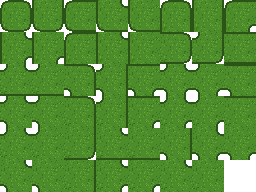 Grass
Grass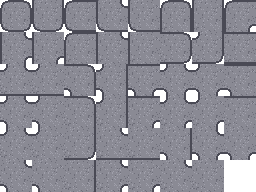 Stone
Stone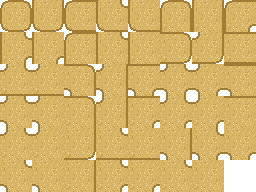 Sand
Sand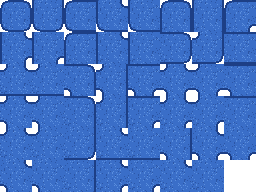 Water
Water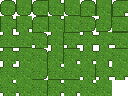 Grass
Grass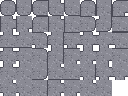 Stone
Stone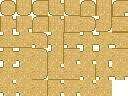 Sand
Sand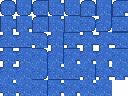 Water
Water16 tiles — Match Sides
Same art, one third of the tiles. Only the four orthogonal neighbours are matched, so a diagonal touch does not connect — which is what you want for pipes, fences, wires, roads and cave walls.
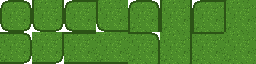 Grass
Grass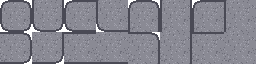 Stone
Stone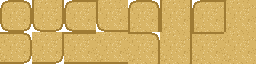 Sand
Sand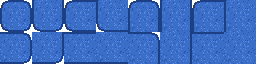 Water
Water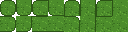 Grass
Grass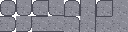 Stone
Stone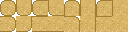 Sand
Sand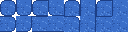 Water
WaterThe four terrains carry different names on purpose: the Terrains palette shows the terrain name, so sixteen of these open in one project stay tellable apart. The 48th cell of a 47-blob sheet is empty — 47 tiles do not divide by 8; a 16-tile sheet fills its 8×2 exactly.
Drop it in — three steps, about twenty seconds
- Copy both files of one row — the
.pngand the.tres— into your project, any folder. They have to land in the same folder: the.trespoints at the PNG by bare filename, on purpose, so the pair works wherever you put it. - Let the editor import the PNG. It does this by itself when the Godot window regains focus. Don't copy an
.importfile from anywhere — Godot writes its own. - Add a
TileMapLayer, set itsTileSetto the.tres, open the TileMap panel → Terrains tab, pick Connect mode, and paint.
No plugin needed for this pack. Godot 4.3 or newer — TileMapLayer does not exist in 4.2, so step 3 has nothing to paint on there.
What is already wired inside each .tres
- 47 tiles in the
_47blob_files — the full blob set: every corner/side combination that can actually occur. (Not 256. Why 47 and not 256, asked of Godot 4.7 all 256 times.) 16 tiles in the_16sides_files — every combination of the four sides. - Terrain set 0, mode Match Corners and Sides (47-blob) or Match Sides (16-tile), one terrain named after the material. Each
.tresdeclares its own mode, so you never set it by hand. - Peering bits on every tile — this is the part that makes Connect mode pick the right tile instead of leaving a hole the engine fills silently with the wrong one. The 16-tile files carry the four side bits and no corner bits; that difference is the layout.
- Collision — a full-square polygon on every tile, physics layer 0. Want the terrain walkable instead? Delete the physics layer in the TileSet inspector.
[ext_resource type="Texture2D" path="grass_47blob_16px.png" id="1_bsmith"]
...
1:0/0/terrain_set = 0
1:0/0/terrain = 0
1:0/0/terrains_peering_bit/top_side = 0
1:0/0/physics_layer_0/polygon_0/points = PackedVector2Array(-8, -8, 8, -8, 8, 8, -8, 8)
Verified in a real engine, not asserted
These files are not "should work". Each of the sixteen was loaded headless in a real Godot build, painted onto a real TileMapLayer with set_cells_terrain_connect, and read back — 216 checks in total. Run on three stable builds on 1 September 2026:
| Godot | starter pack |
|---|---|
| 4.3.stable | 216 pass / 0 fail |
| 4.4.stable | 216 pass / 0 fail |
| 4.7.stable | 216 pass / 0 fail |
Per tileset: the .tres loads with the relative texture path, the atlas source and texture resolve, the sheet is the expected size, the declared number of tiles is present, tile size is right, the terrain mode is the one that layout needs, the terrain carries its name, the physics layer exists, every tile has a collision polygon, a 20-cell terrain paint fills every cell, and the interior cell reports all 4 side peering neighbours — plus, in the 47-blob files, all 4 corners. The gate iterates manifest.json inside the pack and reads each entry's tile count and mode from it, so a new tileset cannot skip the engine and the 16-tile files are not held to a check loose enough for both layouts to pass. One measured limit: injecting a corner peering bit into a 16-tile .tres still passes the engine gate, because Godot normalises corner bits away in MATCH_SIDES — so that claim is asserted on the written bytes by the generator instead, and the engine-side corner check is scoped to the layout where it can fail.
Honest about the art
This is procedural placeholder art, not a hand-drawn asset pack. It is for prototyping, for learning how Godot 4 terrains behave, and — the reason it exists — as a sheet you know is correct when your own tileset paints the wrong tile and you cannot tell your bug apart from the engine's behaviour. It will not carry the look of a finished game. Swap it for your own art when you have some.
The layout, though, is the real thing: if your own 47-tile or 16-tile sheet matches the corresponding sheet's ordering, it wires up exactly the same way.
When your own tiles misbehave
The pack is the control sample. These pages are the measurements, each one with the scanner or the in-page tool that answers it:
- Godot put the wrong tile down — it is not random and it is not borrowing from another terrain.
- A one-pixel line between tiles — four causes, four fixes, and the answer repeated most often online is a Godot 3 setting that no longer exists.
- Y-sorted and still drawing in the wrong order — the field everyone drags is not in the sort key.
- What is inside
tile_map_data— paste your.tscnand read the cells back. - TileMap is deprecated — convert it — these TileSets drop straight into a
TileMapLayer; if your scenes still useTileMap, this converts them in one pass. The ones carrying a script go through the script port first. - Nine scanners for a Godot 4 project — the offline MIT bundle, one question each, exit 1 on findings so they work in CI.
Your own art, wired the same way
Already have a 47-blob sheet?
The Blobsmith Autotile Wirer addon — MIT, free, no account — turns any sheet in either layout into a wired .tres from inside the editor: Project > Tools > Blobsmith Autotile Wirer…. Verified headless on Godot 4.3, 4.4 and 4.7.
Have art, but not 47 tiles of it?
Blobsmith composes both sheets from the same 6-tile base block — the mode selector switches between 47 and 16 — and exports this exact .png + .tres pair. The sixteen files above are its output, not a lookalike built by a side script. Draw the block in your browser for free: Blobsmith Lite · full version with the Godot and Tiled exports: Blobsmith on itch.io.
Each file in the pack carries one terrain. Need four of them in one tileset? Merge them here — pasting two of these together by hand loses a terrain silently, because every one of them names its atlas TileSetAtlasSource_bsmith.
Brought your own sheet instead? Drop it in the generator and get the same kind of .tres for your art — tile size read off the image, transparent slots named before the download.